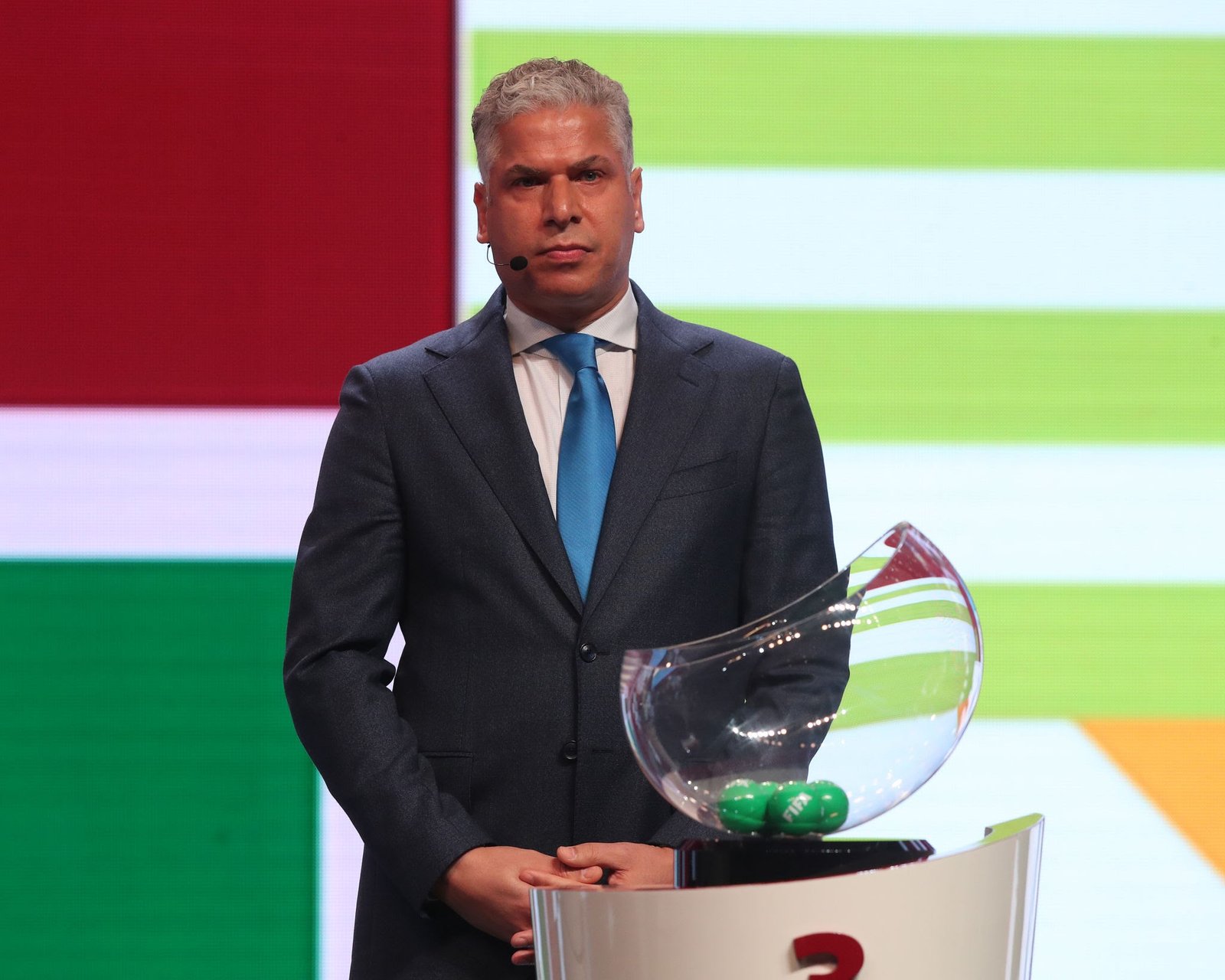
German football official Oke Göttlich has sparked widespread debate after suggesting that football authorities should be willing to discuss the possibility of boycotting major tournaments under certain political circumstances.
Göttlich, who serves as vice president of the German Football Association (DFB) and president of FC St. Pauli, found himself at the centre of a national conversation after comments questioning whether sporting participation should always take precedence over geopolitical concerns.
The 50-year-old clarified that he never explicitly called for Germany to boycott the 2026 FIFA World Cup, but instead argued that football should not be exempt from broader discussions about global affairs and human rights.
“At no point did I say Germany should boycott the 2026 World Cup,” Göttlich explained in comments to Spanish newspaper El País.
“I was asked whether I thought it was right or wrong to go and play in a country that had only days earlier threatened to take Greenland by force, and I simply reflected on the issue and opened the debate.”
His remarks generated significant discussion across Germany, where football holds enormous cultural importance and the men’s national team remains one of the most successful in World Cup history.
The comments also prompted a response from within the German Football Association, with the federation distancing itself from any suggestion that Germany could withdraw from the tournament.
Göttlich, however, insists the broader conversation remains relevant.
“What I have been saying for months is that we must open our minds and accept the debate. We have to ask ourselves whether we should go to the World Cup,” he said.
“Germany will go and play, but I am worried about the underlying issue.”
The football administrator argued that major sporting events have increasingly been staged in countries facing criticism over political or human rights issues and believes football should not ignore such discussions.
He pointed to previous World Cups and Olympic Games hosted by nations that attracted international scrutiny and questioned whether football organisations should take a stronger stance on issues beyond the pitch.
Göttlich also revealed that discussions had taken place within German football circles regarding potential scenarios that could trigger a boycott debate, although he stressed that such circumstances had not materialised.
The controversy highlights the growing intersection between sport, politics and human rights, a topic that has become increasingly prominent in international football in recent years.
With the 2026 FIFA World Cup set to be hosted across the United States, Canada and Mexico, discussions surrounding the role of football in addressing political and social issues are likely to remain part of the wider conversation as the tournament approaches.