
Nearly 20,000 coaches have been certified across Africa since 2021 as CAF’s investment in technical education continues to expand the continent’s coaching pool ahead of the 2030 FIFA World Cup.
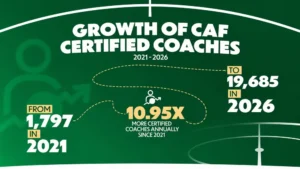
Figures released ahead of the CAF Strategy Conference in Sal, Cabo Verde, show that 19,685 coaches obtained CAF coaching qualifications between 2021 and 2026.
The figures highlight the growing emphasis on coach education as CAF seeks to strengthen the technical foundations of African football.
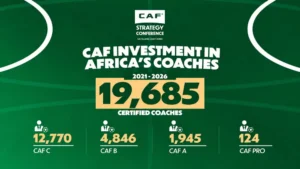
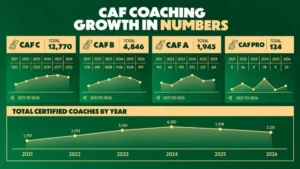
Of those certified during the six-year period, 12,770 obtained CAF C licences, while 4,846 received B licences. A further 1,945 coaches achieved A licences and 124 reached the CAF Pro level.
The growth in coaching education has coincided with a greater presence of African coaches at the highest level.
Six of Africa’s 10 representatives at the 2026 FIFA World Cup were led by African coaches, a significant increase from previous tournaments.
In 2010, only one African coach was in charge of a team from the continent at the World Cup. The number increased to two in 2014 and remained at two in 2018 before all five African representatives at the 2022 tournament were coached by Africans.
That number rose to six at the 2026 World Cup, when Africa had 10 representatives.
The development of coaching will be a major part of discussions at the CAF Strategy Conference, which takes place from 7-9 October in Sal, Cabo Verde.
CAF, its 54 Member Associations, national team coaches and international football experts will examine how the progress made in technical education can be strengthened as African football looks towards 2030.
Nearly 20,000 coaches certified
The figures show the scale of CAF’s efforts to increase the number of qualified coaches across its member associations.
A total of 19,685 coaches completed certification between 2021 and 2026, with qualifications spread across the four levels of the CAF coaching pathway.
The C licence accounted for the largest share, with 12,770 coaches reaching that level. Another 4,846 obtained B licences, while 1,945 reached A level.
At the highest stage of the pathway, 124 coaches secured CAF Pro licences.
The annual figures also demonstrate the expansion of coaching education during the period.
There were 1,797 coaches certified across the four levels in 2021. That figure increased to 2,593 in 2022 and 3,746 in 2023.
The number reached 4,280 in 2024, the highest annual total during the six-year period. A further 3,938 coaches were certified in 2025, followed by 3,331 in 2026.
The figures point to a widening network of qualified coaches working across domestic, youth and senior football.
From investment to World Cup opportunities
The impact of that investment has become increasingly visible at international level.
African coaches have historically had limited representation at the World Cup, despite the continent’s long history of producing players who compete at the highest level.
The breakthrough began to become more noticeable in 2022, when all five African teams at the World Cup were led by African coaches.
Four years later, six of the continent’s 10 representatives had African coaches in charge.
Africa also produced its strongest collective World Cup performance in 2026, with nine of its 10 teams reaching the knockout stage.
Among the coaches who made an impact was Bubista, who guided Cabo Verde to their first World Cup and then led the debutants into the knockout stage.
Emerse Faé took Côte d’Ivoire into the knockout rounds for the first time in the country’s history, while Hossam Hassan led Egypt at the tournament.
The progress also follows Walid Regragui’s landmark achievement in 2022, when he became the first African coach to guide a team to a World Cup semi-final after taking Morocco into the last four.
Coaching takes centre stage
The figures will provide an important backdrop to the CAF Strategy Conference, where discussions will look beyond individual tournament performances and consider how African football can make its progress sustainable.
Coach education, licensing, knowledge-sharing and pathways from domestic football to elite national-team management are expected to form part of the wider discussion.
The performances of Africa’s 10 teams at the 2026 World Cup will also be examined, with CAF and its member associations seeking lessons that can be applied across the continent.
The focus will extend beyond what happened during matches to how coaches were prepared, the support provided by technical departments and the structures needed to develop coaches capable of working at the highest level.
The number of coaches certified between 2021 and 2026 provides evidence of a growing technical base.
The next challenge is to ensure those coaches have access to opportunities, further education and clear pathways through youth, club and national-team football.
The increase from one African World Cup coach in 2010 to six in 2026, alongside the 19,685 coaches certified over the past six years, reflects the growth of technical education across the continent.
As African football looks towards 2030, the Strategy Conference in Cabo Verde will consider how that progress can be accelerated and how a larger pool of qualified African coaches can contribute to the continent’s next stage of development.