Egypt’s 1-0 friendly victory over Russia at Cairo International Stadium has provided the clearest indication yet of how coach Hossam Hassan intends to approach the 2026 World Cup.
The Pharaohs secured victory through a goal from Mostafa Abdel Raouf Zico in what was Egypt’s final match on home soil before the team travels to the United States for the next phase of preparations.
Egypt is scheduled to face Brazil in another friendly match in Ohio on 7 June before beginning its World Cup campaign.
Beyond the result itself, the encounter against Russia appeared to reveal several tactical ideas that Hassan may rely upon during the tournament, particularly regarding formation, attacking movement and pressing intensity.
During the 2025 Africa Cup of Nations, Hassan frequently adopted a system built around three defenders and two advanced attackers, often using a shape similar to 3-5-2 with Mohamed Salah and Omar Marmoush operating together in attack.
The Russia match, however, saw Egypt line up in a 4-2-3-1 formation, although the underlying tactical concepts remained similar.
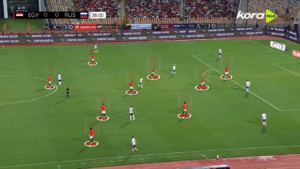
Rather than using a traditional lone striker system, Hassan again appeared to favour a more flexible attacking structure built around movement between the front players.
During several phases of play, Emam Ashour operated as a withdrawn attacker behind Marmoush, frequently advancing into central attacking positions whenever the forward dropped deeper to receive possession.
The arrangement appeared designed to maximise Marmoush’s strengths while reducing the limitations associated with using him as an isolated striker.
Marmoush, who plays for Manchester City FC, is generally viewed as more effective operating behind or alongside another forward rather than as a pure centre-forward.
The article noted that the player struggled when deployed alone in attack at club level but excelled in a secondary attacking role during his time with Eintracht Frankfurt.
The same tactical logic could also benefit Salah, whose role increasingly appears to be evolving away from that of a traditional winger.
Egypt’s winning goal reflected those tactical principles.
Zico entered the match in place of Emam Ashour and performed a similar role by making late attacking runs into the penalty area.
The Pyramids FC player eventually scored with a header from a cross delivered by Mohamed Hany following good work down the right side involving Haitham Hassan.
The goal marked Zico’s first international goal on his senior debut and made him the 15th different player to score for Egypt since Hossam Hassan became national team coach.
Although Hassan introduced three substitutions as early as the 34th minute — bringing on Haitham Hassan, Zico and Ibrahim Adel in place of Ahmed Sayed Zizo, Emam Ashour and Mahmoud Hassan Trezeguet — the overall tactical structure remained largely unchanged.
Another significant feature of Egypt’s performance was the team’s aggressive pressing strategy.
In previous major matches, Hassan often preferred a more conservative defensive approach, with pressing beginning deeper inside Egypt’s own half.
Against Russia, however, Egypt adopted a far more advanced pressing system, attempting to disrupt the opposition during the early stages of build-up play.
The tactical adjustment involved multiple players pushing forward simultaneously, while defenders also stepped higher up the pitch in support.
Although such an approach could expose Egypt defensively against stronger opposition at the World Cup, it proved effective in preventing Russia from comfortably controlling possession.
The performance nevertheless leaves open an important question regarding whether the strategy represented a permanent tactical evolution or merely an approach tailored specifically for this opponent.
Russia, while still regarded as physically strong and tactically organised, has faced a more limited schedule of top-level European competition in recent periods.
Egypt now prepares to travel to Ohio for its final pre-World Cup camp before entering Group G, where the team will face Belgium, Iran and New Zealand.
As preparations continue, the tactical identity of Hossam Hassan’s Egypt appears to be becoming increasingly defined.