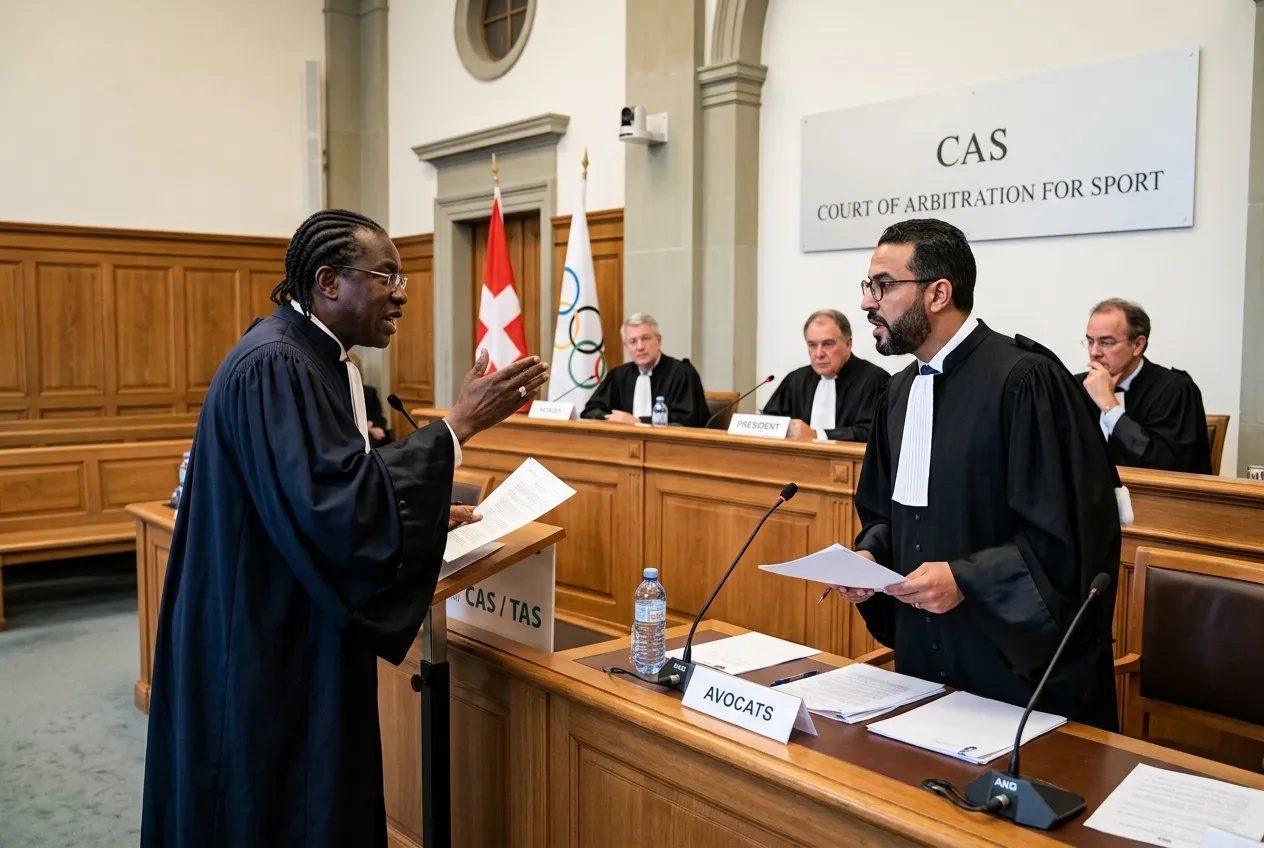

The Court of Arbitration for Sport (CAS) began hearing arguments in Lausanne on Thursday over the disputed 2025 Africa Cup of Nations final between Morocco and Senegal.
The case centres on two sharply different interpretations of the regulations. Morocco relies on Articles 82 and 84 of the competition rules, while Senegal argues that the match was decided on the pitch after referee Jean Jacques Ndala allowed its players to return following a temporary walk-off and then resumed the game.
Senegal won 1-0 after extra time, but the Confederation of African Football (CAF) Appeals Committee later annulled the result, declared Senegal to have forfeited the match and awarded Morocco a 3-0 victory.
The key legal question in Lausanne is what effect the players’ departure from the field had after they subsequently returned and completed the match. The hearing will also examine whether an administrative body can overturn a result that was allowed to stand by the referee until the final whistle.
Senegal’s defence is expected to place significant emphasis on Law 5 of the Laws of the Game, issued by the International Football Association Board (IFAB). That law gives the referee authority to control the match and makes decisions concerning facts connected with play final.
Senegal maintains that Ndala permitted its players to come back on, restarted the game and managed it until its conclusion. The central argument is whether a governing body can later cancel a result once the referee has authorised the match to continue and declared an on-field winner.
Sports lawyer Pius Ndobwuku told SABC: “They returned to the pitch, the match continued, and then the referee blew the final whistle.” He said CAF’s Appeals Committee could not overturn the decision made by the referee during the game.
Senegal may also argue that there is no specific provision covering a team that leaves the field temporarily, returns and then completes the match. Its legal team is led by Spanish lawyer Juan de Dios Crespo-Perez, who described the reopening of a match that had already ended as “unprecedented” when announcing the appeal. He said the case could raise questions extending beyond African football and concerning the future rules of the game.
The Senegalese side may distinguish the incident from previous cases in which teams refused to complete matches, including the second leg of the 2019 CAF Champions League final between Esperance de Tunis and Wydad AC. Its position is that its players did return and resume play.
Morocco, however, is seeking what it considers a literal application of Articles 82 and 84. Those provisions state that a team can be deemed to have lost if it refuses to play or leaves the field before the match ends without the referee’s permission. Depending on the circumstances, it can be recorded as a 3-0 defeat and expelled from the competition.
Fouzi Lekjaa, president of the Royal Moroccan Football Federation, told Jeune Afrique that the football and legal rules governing the match had been “obstructed and violated” by the opposition. He also said FIFA had changed its regulations after the incident, meaning a player who leaves the pitch without permission can be shown a red card.
Morocco further points to a moment when Senegal had only three players on the field, compared with the minimum of seven required for a team to continue a match. Its argument is that the offence was complete when the players left and that their later return did not erase what had occurred.
The CAS must therefore decide whether strict enforcement requires the final result to be cancelled, or whether the resumed match and final whistle protect the sporting outcome while leaving other disciplinary sanctions possible. Senegal goalkeeper Edouard Mendy said in March: “We know how we won the Africa Cup of Nations, and we know what happened on one of the nights in February in Morocco.” Former Morocco manager Walid Regragui said: “For me, I am the champion of Africa, whether some people like it or not.”